011-49851163
8750500323
support@bluespaceinnovations.in
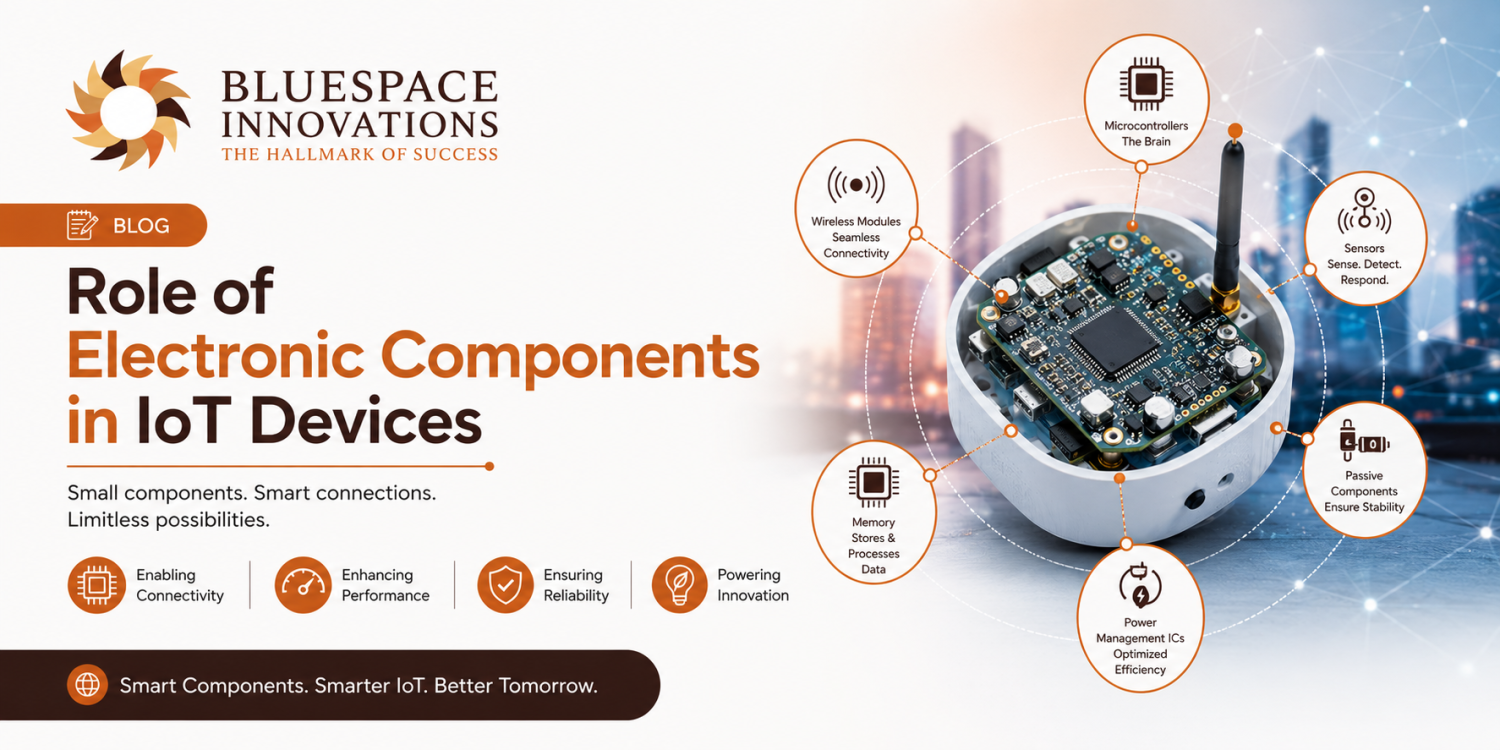
The Internet of Things (IoT) is transforming the way we live, work, and interact with technology. From smart homes and wearable gadgets to industrial automation and healthcare systems, IoT devices are creating a connected ecosystem that improves efficiency, convenience, and productivity.
Behind every successful IoT device lies a combination of powerful electronic components working together seamlessly. At Blue Space Innovations, we provide high-quality electronic components that help engineers, developers, startups, and innovators build advanced IoT solutions.
In this blog, we explore the important role electronic components play in IoT devices and why choosing the right components is essential for performance and reliability.
IoT devices are smart electronic systems connected to the internet that can collect, share, and process data in real time.
These devices rely heavily on electronic components to function effectively.
Sensors are among the most important components in IoT systems. They collect data from the environment and convert physical parameters into electrical signals.
Accurate sensors improve data collection and overall device performance.
Microcontrollers process the data collected by sensors and control the functioning of the IoT device.
Modern IoT devices require energy-efficient and high-speed microcontrollers for seamless operation.
Connectivity is the foundation of IoT technology. Communication modules allow devices to exchange data with other systems and cloud platforms.
Reliable communication modules ensure stable and secure data transmission.
Power management is critical in IoT devices, especially for battery-operated systems.
Efficient power systems increase the lifespan and reliability of IoT devices.
PCBs connect all electronic components together and provide the structural foundation of IoT devices.
Custom PCB designs are widely used in advanced IoT applications.
IoT devices often need memory to store data, firmware, and application settings.
Reliable storage components are essential for smooth device operation.
Actuators perform physical actions based on commands received from the microcontroller.
Actuators help IoT devices interact with the physical world.
Integrated Circuits are compact semiconductor devices that perform multiple electronic functions.
ICs are essential for creating compact and intelligent IoT systems.
Many IoT devices include displays for monitoring and user interaction.
Displays improve user experience and system monitoring.
The performance of an IoT device depends heavily on the quality of its components.
Using reliable components ensures:
At Blue Space Innovations, we offer premium electronic components for:
We help students, startups, engineers, and businesses build innovative IoT solutions with trusted electronic products and technical support.
The future of IoT is rapidly expanding with technologies like:
As IoT devices become smarter and more connected, the demand for advanced electronic components will continue to grow.
Electronic components are the backbone of every IoT device. From sensors and microcontrollers to communication modules and power systems, each component plays a vital role in building efficient and intelligent connected devices.
With the increasing adoption of IoT technology across industries, choosing high-quality electronic components has become more important than ever. Blue Space Innovations is committed to supporting the next generation of IoT innovation with reliable electronic solutions.
Mail: support@bluespaceinnovations.in
Call on: 011-49851163
Whatsapp us 8750500323