011-49851163
8750500323
support@bluespaceinnovations.in
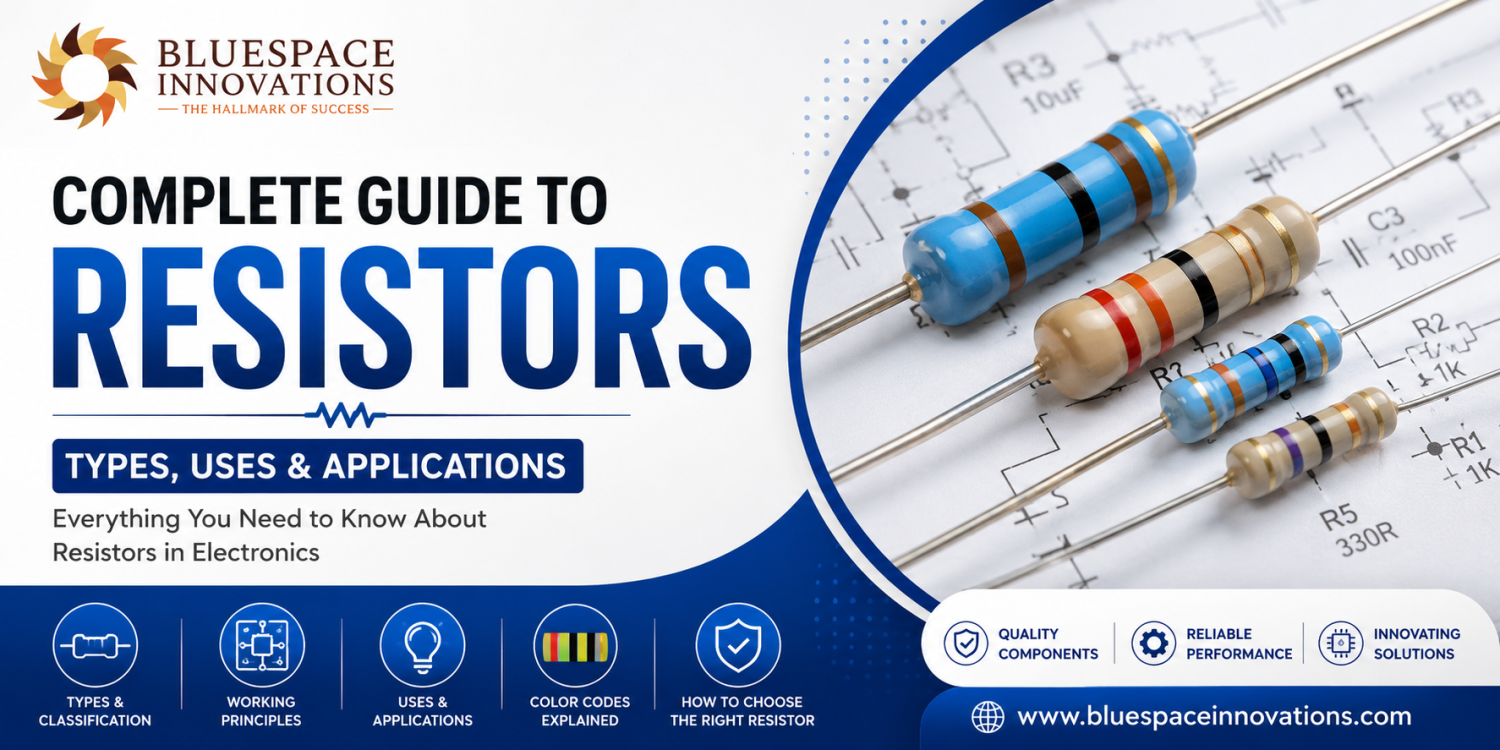
Whether you are a beginner learning electronics or a professional engineer designing complex systems, understanding resistors is fundamental. In this complete guide by Blue Space Innovations, we will explore resistor types, their working principles, applications, and how to choose the right resistor for your projects.
A resistor is a passive electronic component designed to limit or regulate the flow of electric current in a circuit. It creates resistance, which helps manage voltage and current levels across electronic devices.
Resistors are measured in Ohms (Ω) and are commonly used in nearly every electronic circuit.
Control electrical current
Divide voltage
Protect components from excessive current
Generate heat in specific applications
Pull-up and pull-down operations in digital circuits
Signal conditioning
Resistors are broadly classified into two main categories:
Fixed resistors have a constant resistance value.
These are made from carbon powder mixed with a binding material. They are inexpensive and widely used in basic electronic circuits.
Applications:
Audio circuits
Power supplies
Consumer electronics
Carbon film resistors provide better accuracy and lower noise compared to carbon composition resistors.
Advantages:
Affordable
Reliable performance
Good temperature stability
Metal film resistors offer high precision and low noise performance.
Applications:
Medical equipment
Communication devices
Precision electronic systems
These resistors are made by winding metal wire around a ceramic core.
Best For:
High-power applications
Industrial machinery
Motor controls
Fusible resistors act as both a resistor and a fuse. They protect circuits from overcurrent conditions.
Variable resistors allow users to adjust resistance manually.
Potentiometers are commonly used for controlling voltage levels.
Examples:
Volume controls
Light dimmers
Adjustable power supplies
Rheostats are used to control current flow in high-power circuits.
Trimmers are small adjustable resistors mainly used for calibration.
Thermistors change resistance according to temperature.
Applications:
Temperature sensors
HVAC systems
Battery protection circuits
Light Dependent Resistors (LDRs) change resistance based on light intensity.
Used In:
Street lights
Camera sensors
Automatic lighting systems
Varistors protect circuits from voltage spikes and surges.
Most resistors use colored bands to indicate resistance value and tolerance.
Black = 0
Brown = 1
Red = 2
Orange = 3
Yellow = 4
Green = 5
Blue = 6
Violet = 7
Grey = 8
White = 9
Tolerance bands:
Gold = ±5%
Silver = ±10%
Understanding resistor color coding is important for identifying resistor values quickly in circuit design and repairs.
Resistors are used in almost every electronic device.
Smartphones
Televisions
Laptops
Audio systems
ECU systems
LED lighting
Battery management systems
PLC systems
Sensors
Motor drives
Monitoring systems
Diagnostic equipment
Precision control circuits
Signal processing
Network devices
RF circuits
Choosing the correct resistor depends on several factors:
Measured in Ohms (Ω), kilo-ohms (kΩ), or mega-ohms (MΩ).
Indicates how much power the resistor can safely dissipate.
Defines accuracy level.
Shows how resistance changes with temperature.
Different applications require different resistor types.
Used in traditional PCB designs and prototyping.
Compact resistors used in modern electronics manufacturing.
Using high-quality resistors ensures:
Better circuit stability
Improved device lifespan
Reduced failure rates
Higher efficiency
At Blue Space Innovations, we provide high-quality electronic components suitable for industrial, commercial, and educational applications.
As electronics continue to evolve, resistor technology is also advancing. Modern resistors are becoming:
Smaller
More precise
Heat resistant
High-frequency compatible
Industries like IoT, EV technology, robotics, and AI-based electronics are increasing demand for advanced resistor technologies.
Resistors are the backbone of electronic circuit design. Understanding resistor types, uses, and applications helps engineers, students, and electronics enthusiasts build efficient and reliable systems.
From fixed resistors to advanced variable resistors, each type serves a unique purpose in modern electronics. Choosing the right resistor improves performance, protects circuits, and ensures long-term reliability.
If you are looking for reliable electronic components in India, Blue Space Innovations offers a wide range of premium-quality resistors and electronic solutions for every application.

Mail: support@bluespaceinnovations.in
Call on: 011-49851163
Whatsapp us 8750500323