Capacitors are among the most essential components in electronics and are widely used for energy storage, filtering, decoupling, timing, and signal processing. Among the different types available, ceramic capacitors and electrolytic capacitors are two of the most commonly used in modern electronic circuits. Understanding the difference between these two capacitor types is important for students, engineers, technicians, and electronics hobbyists who want to build stable and efficient circuits.
A ceramic capacitor uses ceramic material as its dielectric and is known for its compact size, non-polarized nature, excellent stability, and strong high-frequency performance. These capacitors are generally available in low to medium capacitance values and are commonly used in microcontroller circuits, RF applications, IC decoupling, oscillators, and noise filtering. Because of their low ESR and fast response, ceramic capacitors are highly effective in reducing high-frequency switching noise.
An electrolytic capacitor, on the other hand, uses an electrolyte and oxide layer as the dielectric material. It is mainly preferred in applications where high capacitance values are required. These capacitors are polarized and are commonly used for power supply smoothing, bulk energy storage, ripple filtering, audio amplifier circuits, inverters, LED drivers, and power rails. Their ability to store a larger amount of charge makes them ideal for handling voltage fluctuations and sudden load demands in power circuits.
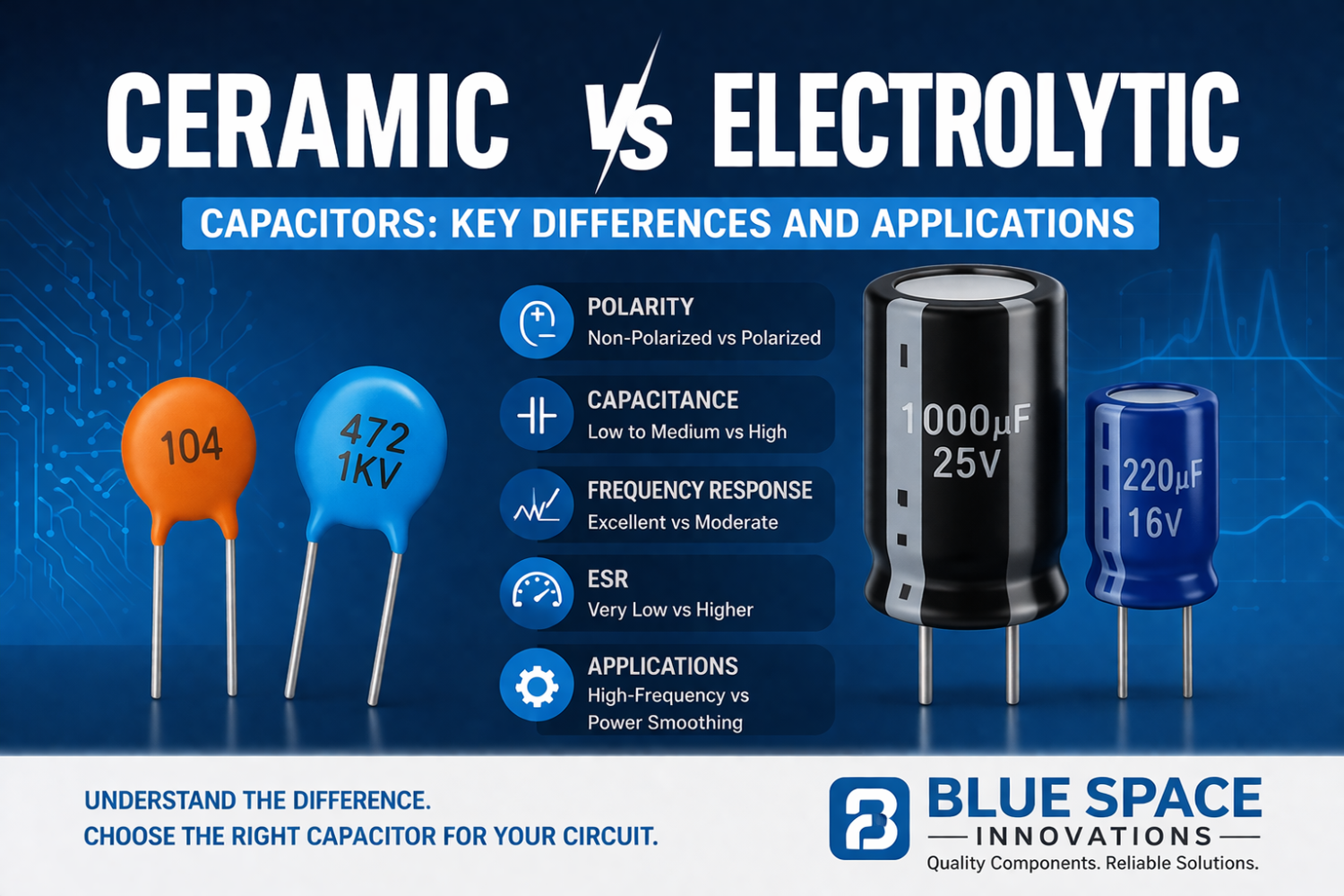
The key difference between ceramic and electrolytic capacitors lies in their capacitance range, polarity, size, and performance characteristics. Ceramic capacitors are non-polarized, smaller in size, and perform exceptionally well in high-frequency applications. Electrolytic capacitors, however, offer much higher capacitance values, are larger in size, and are better suited for low-frequency ripple filtering and energy storage tasks. Ceramic capacitors typically have lower ESR and a longer lifespan, while electrolytic capacitors are more practical for applications requiring large capacitance in a cost-effective way.
When choosing between ceramic and electrolytic capacitors, the application plays the most important role. Ceramic capacitors are ideal when the circuit requires compact size, low ESR, and high-speed filtering near ICs or processors. Electrolytic capacitors are the better choice when the design involves power supply sections, voltage smoothing, motor drivers, or circuits that need bulk energy storage. In many real-world circuit designs, both capacitor types are used together to ensure maximum stability, with ceramic capacitors handling high-frequency noise and electrolytic capacitors managing ripple and power fluctuations.
Although it may seem possible to replace one capacitor with the other if the capacitance values are similar, this is not always recommended. Both capacitor types differ significantly in ESR, ripple current capability, frequency response, and voltage behavior. Replacing an electrolytic capacitor with a ceramic capacitor without understanding the circuit requirements can lead to unstable performance or reduced efficiency. Therefore, capacitor replacement should always be based on the exact needs of the application.
Blue Space Innovations offers a wide range of premium-quality ceramic capacitors, electrolytic capacitors, tantalum capacitors, and other electronic components for students, engineers, manufacturers, and repair professionals across India. With reliable stock, competitive pricing, and fast nationwide delivery, Blue Space Innovations is a trusted destination for sourcing high-quality electronic components online.
In conclusion, both ceramic and electrolytic capacitors serve critical roles in electronics. Ceramic capacitors are preferred for speed, stability, and high-frequency performance, while electrolytic capacitors are best suited for high capacitance, power smoothing, and bulk energy storage. A clear understanding of their differences helps in designing more reliable, efficient, and durable electronic circuits.