011-49851163
8750500323
support@bluespaceinnovations.in
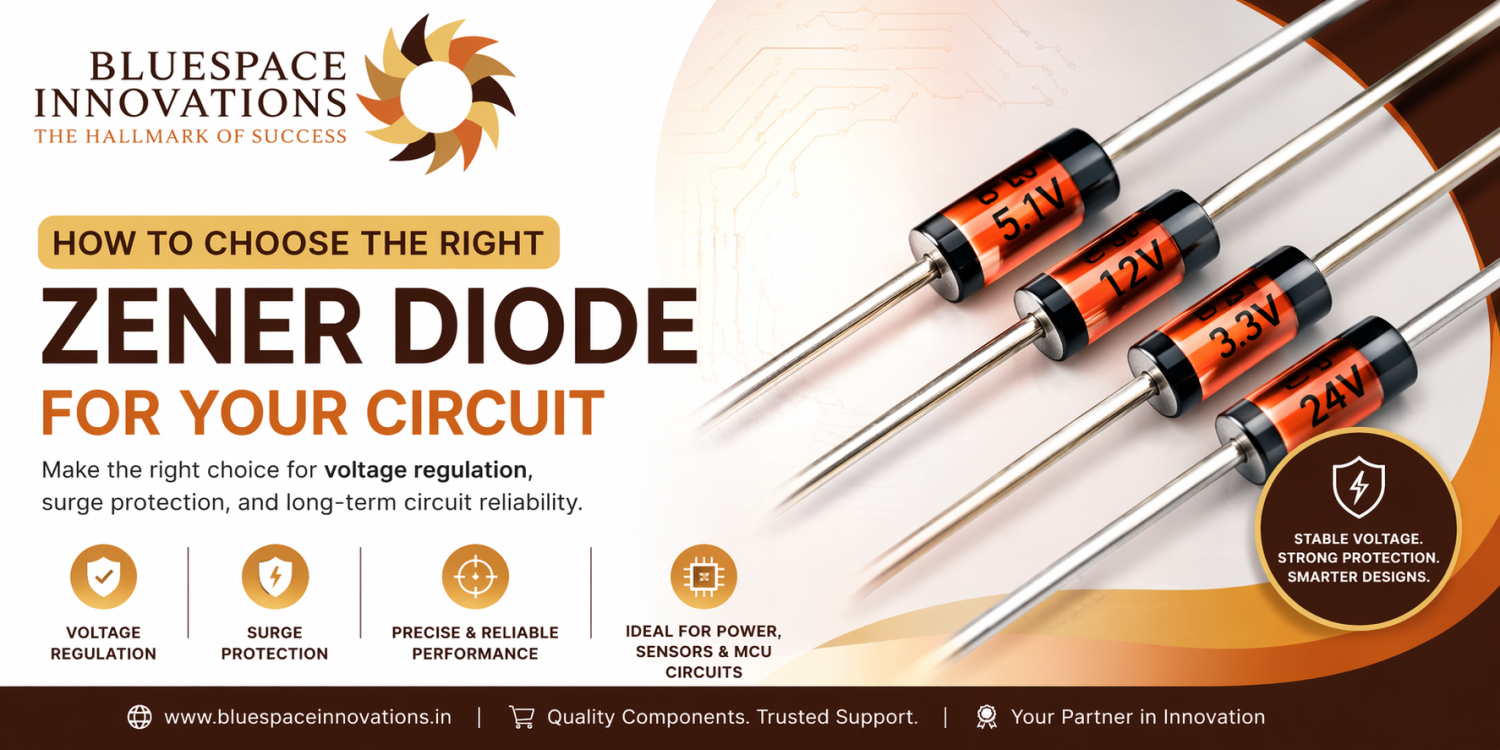
A Zener diode is an essential electronic component used for voltage regulation, surge protection, and providing a stable voltage reference in circuits. Selecting the right Zener diode is important to ensure long-term circuit safety and efficient performance.
The first thing to consider is the Zener voltage (Vz). This is the voltage at which the diode starts conducting in reverse bias and regulates the voltage. For example, a 5.1V Zener diode is ideal for 5V microcontroller protection circuits, while 12V Zener diodes are commonly used in 12V power supply applications.
The second important factor is the power rating. Zener diodes are generally available in 1/2W and 1W variants, and the right choice depends on how much current the diode will handle during voltage regulation. Higher wattage Zener diodes are better for circuits that may experience surges or continuous current flow.
You should also check the tolerance level. For general-purpose protection circuits, a ±5% tolerance is usually sufficient. However, precision applications like analog circuits, ADC references, and sensor modules benefit from tighter tolerances such as ±1% or ±2%.
The application type also plays a major role. Low-voltage Zener diodes like 3.3V and 5.1V are best for GPIO and sensor protection, while higher voltages such as 12V, 24V, and 30V are ideal for power rail protection and industrial electronics.
Another critical factor is the series resistor, which limits the current through the Zener diode. A properly calculated resistor ensures safe operation and prevents overheating, improving component life and circuit reliability.
By selecting the right Zener voltage, wattage, tolerance, and resistor value, you can improve the stability and safety of your electronic designs.


Mail: support@bluespaceinnovations.in
Call on: 011-49851163
Whatsapp us 8750500323